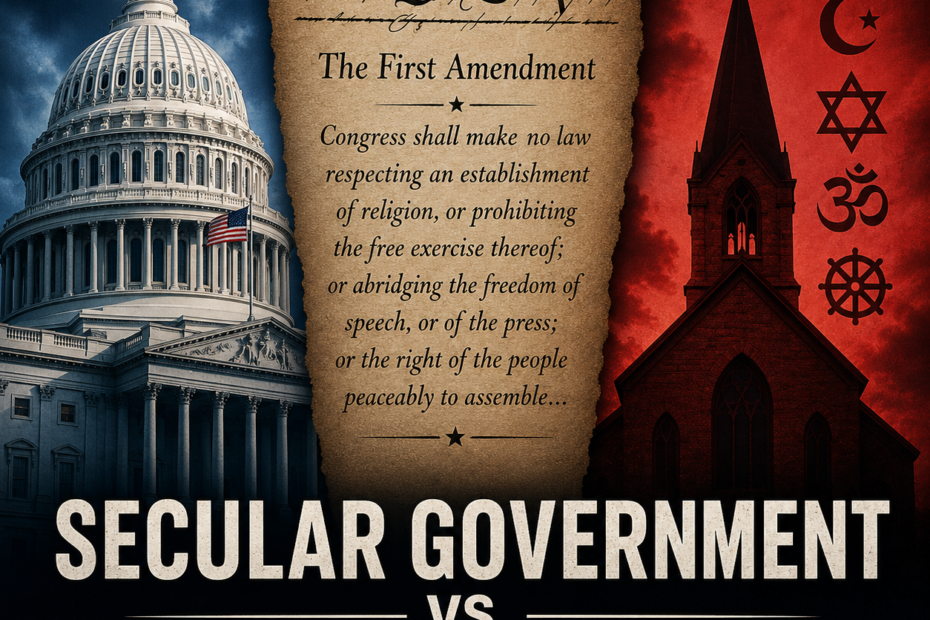
The Constitution establishes a system of religious liberty and government neutrality, which means no religious faction has the right to impose its doctrine through the government.
Let’s say we have multiple religious factions arguing that they want to impose their religious doctrine and place it into the government (which is what the First Amendment forbids).
They claim that they know the ultimate truth because of their ‘holy books’ and because they believe in God.
There are several problems with that argument.
First, I do not expect them to be able to prove that they have some special divine communication with God, that they uniquely understand God’s will, or that their interpretation is the correct one.
Second, even if they sincerely believe that, they would still have to explain why their religious faith should be implemented through the government so that everyone else is forced to follow their religious tradition and religious system.
This is not just about Christianity.
The same principle applies to Islam, Hinduism, Judaism, or any religion that seeks to impose its doctrine and replace the secular constitutional system with religious rule.
We cannot simply assume that any particular group knows God’s will.
We can speculate that there may have been a creator or some mysterious event at the origin of reality, but that does not grant any religion special divine authority, especially over people who do not share those beliefs.
That is precisely why secular government exists.
People are free to practice their religion privately.
They are free to believe that they understand God’s truth and God’s will.
But they are not entitled to enforce those beliefs through the government.
Any religion can claim that it possesses ultimate truth.
Any religion can argue that God endorses its worldview.
In fact, many religions make similar claims while reaching completely different conclusions.
So if a religious faction wants to replace the secular Constitution with its own doctrine, the obvious question is: how exactly do they intend to justify that?
If they ask why this is unfair, my response is straightforward:
I did not invent the system.
The United States has operated for more than two centuries(200 years) under a constitutional framework that protects religious liberty while preventing any single religion from establishing political control.
I personally support secular government for several reasons. I am pro-Constitution, pro-secular government, and pro-religious freedom. Society still has to make laws, establish rules, and debate difficult questions. Different issues are always open to discussion, but that does not mean that one religious faction gets automatic authority simply because it claims to speak for God.
Another common claim is that secular people have no moral foundation. That is false. Human beings possess the capacity for morality simply by virtue of being human.
We have empathy, conscience, reason, and the ability to recognize suffering and cooperation.
Of course, people disagree about morality.
Religious people disagree with other religious people.
Non-religious people disagree with one another as well.
Disagreement does not prove that morality requires religion.
Every human being has the capacity for moral judgment, even if people reach different conclusions.
The deeper problem arises when a religious faction rejects the secular constitutional system altogether and claims that this is “God’s land” or that it has a divine birthright to impose its doctrine on everyone else.
At that point, the disagreement is no longer about ordinary political issues. It becomes a disagreement about whether we are even willing to share the same constitutional system.
If one group rejects the social contract that allows people with different beliefs to live together peacefully, then society must decide what comes next.
Explore more from DN:
https://linktr.ee/davincineptune